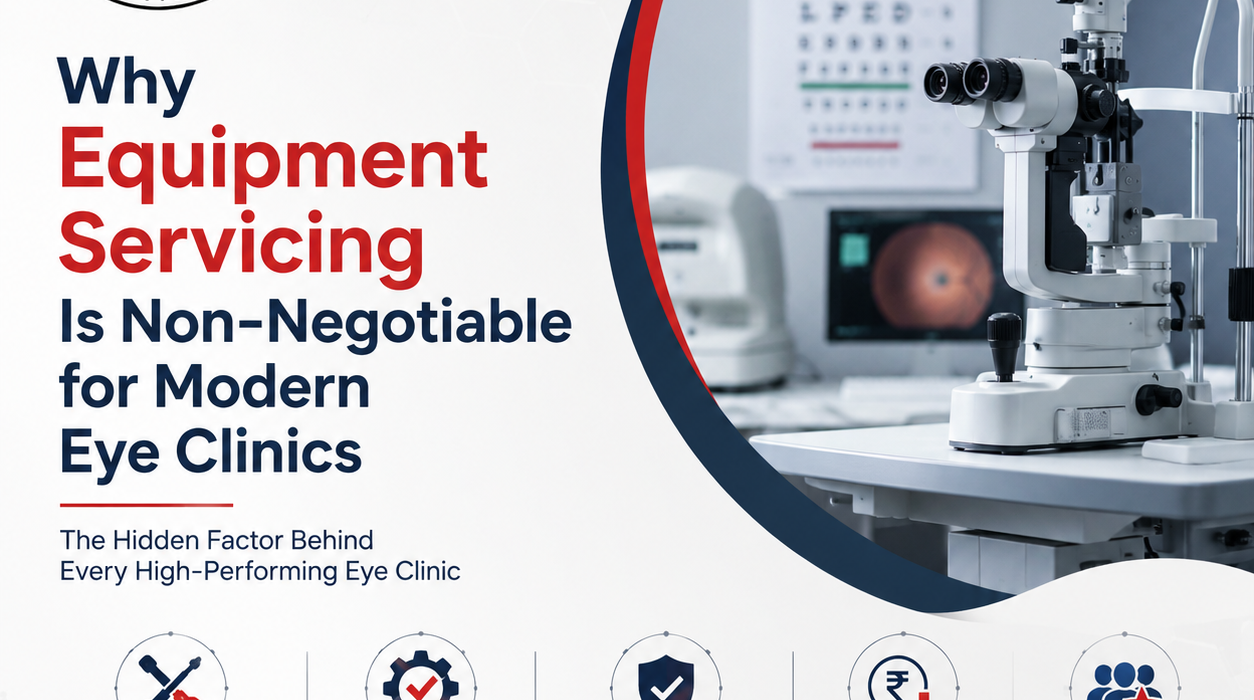
Why Equipment Servicing Is Non-Negotiable for Modern Eye Clinics
The Hidden Factor Behind Every High-Performing Eye Clinic
When ophthalmologists and eye clinic owners invest in advanced diagnostic or surgical equipment, most of the focus naturally goes toward technology, pricing, specifications, and brand reputation. However, one of the most critical factors influencing long-term performance, ROI, and patient satisfaction is often overlooked — equipment servicing and after-sales support.
Whether it is a slit lamp, autorefractometer, phaco machine, OCT system, fundus camera, tonometer, or surgical microscope, ophthalmic equipment operates in a highly precision-dependent environment. Even minor calibration errors or delayed servicing can directly impact diagnostic accuracy, workflow efficiency, and clinical outcomes.
This is why, before procuring any ophthalmic equipment, clinics must evaluate whether the supplier has a dedicated service department capable of providing technical support in the specific region where the equipment will be installed.
At Mediscience Devices, we strongly believe that service support is not an optional add-on. It is a core component of equipment reliability and long-term clinic growth.
Why Ophthalmic Equipment Requires Regular Technical Servicing
Ophthalmic and optometry equipment are highly sensitive diagnostic systems that rely on accurate optics, stable electronics, software synchronization, and mechanical precision.
Over time, environmental conditions, daily usage, voltage fluctuations, dust accumulation, transportation, and operator handling can affect the performance of these devices.
Without periodic servicing, clinics may experience:
- Inaccurate readings and diagnostic inconsistencies
- Reduced image quality in fundus and retinal imaging systems
- Calibration drift in autorefractometers and tonometers
- Reduced illumination performance in slit lamps and indirect ophthalmoscopes
- Software lag or communication errors
- Increased downtime during patient hours
- Premature component failure
- Higher long-term repair costs
In high-volume clinics, even a few hours of equipment downtime can disrupt appointments, reduce patient trust, and affect revenue generation.
The Real Cost of Ignoring Equipment Service Support
Downtime Directly Impacts Patient Flow
A malfunctioning autorefractometer or fundus camera during OPD hours can slow down the entire diagnostic workflow. In busy ophthalmology setups, patient queues move quickly, and any disruption can create operational bottlenecks.
Clinics that depend on a single diagnostic unit are particularly vulnerable.
Delayed Service Means Delayed Diagnosis
Many clinics purchase equipment from suppliers located in distant cities without verifying local service availability. When technical issues arise, they often face:
- Delayed engineer visits
- Lack of spare part availability
- Remote troubleshooting limitations
- Extended equipment inactivity
- Increased transportation costs
This becomes especially problematic in tier-2 and tier-3 cities where immediate technical support may not be easily accessible.
Calibration Errors Can Affect Clinical Accuracy
Modern ophthalmic devices are built around highly precise measurement systems.
For example:
- Auto refractometers depend on accurate refractive calibration
- Keratometers require alignment precision
- Tonometers rely on accurate pressure measurement systems
- Fundus cameras require optical clarity and sensor synchronization
- Phaco systems require fluidics and energy calibration
Without routine servicing, clinics risk inconsistent data acquisition, which can affect both diagnosis and treatment planning.
Why Regional Service Availability Matters Before Equipment Procurement
One of the biggest mistakes clinics make while purchasing equipment is focusing only on product pricing without evaluating the supplier’s technical infrastructure.
Before finalizing any purchase, eye clinics should ask:
Does the supplier have an active service department?
A professional ophthalmic equipment company should have trained service engineers dedicated to installation, maintenance, calibration, troubleshooting, and preventive servicing.
Can they provide support in my region?
Regional accessibility is critical.
If the supplier cannot deploy engineers quickly to your city or nearby area, even minor technical problems can lead to extended downtime.
Do they maintain spare part inventory?
Availability of genuine spare parts significantly reduces repair turnaround time.
Do they provide installation and training?
Correct installation and operator training are essential for maintaining equipment longevity and reducing misuse-related failures.
Do they offer preventive maintenance?
Preventive maintenance helps detect issues before they become expensive repairs.
Preventive Maintenance vs Reactive Repairs
Many clinics only contact service engineers after equipment stops functioning.
This reactive approach often leads to:
- Higher repair expenses
- Longer downtime
- Major component damage
- Reduced equipment lifespan
Preventive maintenance, on the other hand, focuses on periodic inspection and optimization.
Preventive Maintenance Typically Includes:
- Optical cleaning and inspection
- Calibration verification
- Sensor and alignment checks
- Internal dust removal
- Electrical safety inspection
- Software and firmware updates
- Mechanical movement testing
- Lubrication of moving components
- Performance validation
This approach significantly improves reliability and reduces unexpected failures.
The Importance of OEM-Compatible Technical Support
Ophthalmic equipment often contains specialized components and proprietary systems.
Improper servicing by untrained technicians can lead to:
- Permanent optical damage
- Sensor misalignment
- Software corruption
- Reduced device accuracy
- Warranty issues
This is why clinics should work only with suppliers and service providers experienced in ophthalmic equipment servicing.
At Mediscience Devices, our technical support approach focuses on proper diagnosis, genuine component compatibility, and equipment-specific servicing protocols.
Equipment Categories That Require Consistent Servicing
Auto Refractometers & Keratometers
These systems require periodic calibration checks for accurate refractive measurements and keratometry readings.
Fundus Cameras
Portable and tabletop fundus cameras depend heavily on sensor performance, lens cleanliness, autofocus stability, and software optimization.
Slit Lamps
Slit lamps require optical cleaning, illumination inspection, joystick servicing, and alignment calibration.
Phaco Machines
Phaco systems are among the most technically sensitive ophthalmic devices.
Fluidics, vacuum systems, ultrasonic energy delivery, tubing systems, and calibration parameters must be maintained precisely.
Tonometers
Accurate intraocular pressure measurement depends on consistent calibration and sensor stability.
Indirect Ophthalmoscopes
Wireless power systems, illumination modules, and headgear components require periodic inspection.
How Proper Servicing Extends Equipment Lifespan
Well-maintained ophthalmic devices often operate efficiently for many years beyond their expected lifecycle.
Regular servicing helps:
- Improve equipment stability
- Maintain diagnostic consistency
- Reduce sudden breakdowns
- Protect internal components
- Improve workflow efficiency
- Preserve resale value
- Maximize return on investment
For growing eye clinics, this translates into lower operational costs and better long-term profitability.
Servicing Is Also a Patient Experience Factor
Patients may not understand the technical specifications of a fundus camera or autorefractometer, but they immediately notice when clinic operations become slow or inconsistent.
Reliable equipment directly contributes to:
- Faster patient processing
- Better imaging quality
- Accurate diagnostics
- Improved consultation confidence
- Reduced repeat testing
- Enhanced clinic reputation
In today’s competitive ophthalmology landscape, smooth diagnostic workflow is part of the patient experience.
What Eye Clinics Should Look for in an Equipment Supplier
When selecting an ophthalmic equipment supplier, clinics should evaluate more than just product brochures.
An ideal equipment partner should provide:
- Dedicated technical service department
- Regional engineer availability
- Installation and setup support
- Preventive maintenance programs
- Spare parts support
- Operator training
- Remote troubleshooting assistance
- Long-term technical reliability
The true value of an equipment supplier becomes evident after installation — when support and servicing are required.
Why Mediscience Devices Focuses on Technical Support Alongside Equipment Supply
At Mediscience Devices, we understand that ophthalmic equipment is a long-term clinical investment.
Our approach goes beyond simply supplying devices. We focus on supporting eye clinics with:
- Technical guidance
- Equipment installation assistance
- Regional servicing support
- Preventive maintenance
- Product consultation
- Reliable after-sales coordination
Whether it is a portable fundus camera, autorefractometer, slit lamp, phaco system, tonometer, or diagnostic workstation, our goal is to help clinics maintain uninterrupted clinical performance.
Final Thoughts
In ophthalmology and optometry practice, equipment accuracy and reliability are directly linked to patient care quality.
Before purchasing any ophthalmic device, clinics should carefully assess the supplier’s servicing capabilities, technical infrastructure, and regional support availability.
A technologically advanced machine without dependable service support can quickly become a liability.
On the other hand, a reliable equipment partner with active technical support helps clinics maintain smooth operations, reduce downtime, improve diagnostic confidence, and protect long-term investments.
At Mediscience Devices, we believe that professional service support is just as important as the equipment itself.
Need reliable ophthalmic equipment with expert service support? Connect with Mediscience Devices today.
Frequently Asked Questions (FAQ)
Regular servicing helps maintain diagnostic accuracy, prevents unexpected breakdowns, improves equipment lifespan, and ensures consistent clinical performance.
Most ophthalmic devices should undergo preventive maintenance every 6 to 12 months, depending on usage volume, operating conditions, and manufacturer recommendations.
Improper calibration can lead to inaccurate readings, reduced imaging quality, inconsistent measurements, and unreliable diagnostic outcomes.
Regional service availability ensures faster technical assistance, reduced downtime, easier spare part access, and quicker issue resolution.
Yes. Mediscience Devices supports clinics with equipment consultation, technical guidance, installation coordination, preventive maintenance assistance, and after-sales support for various ophthalmic and optometry devices.