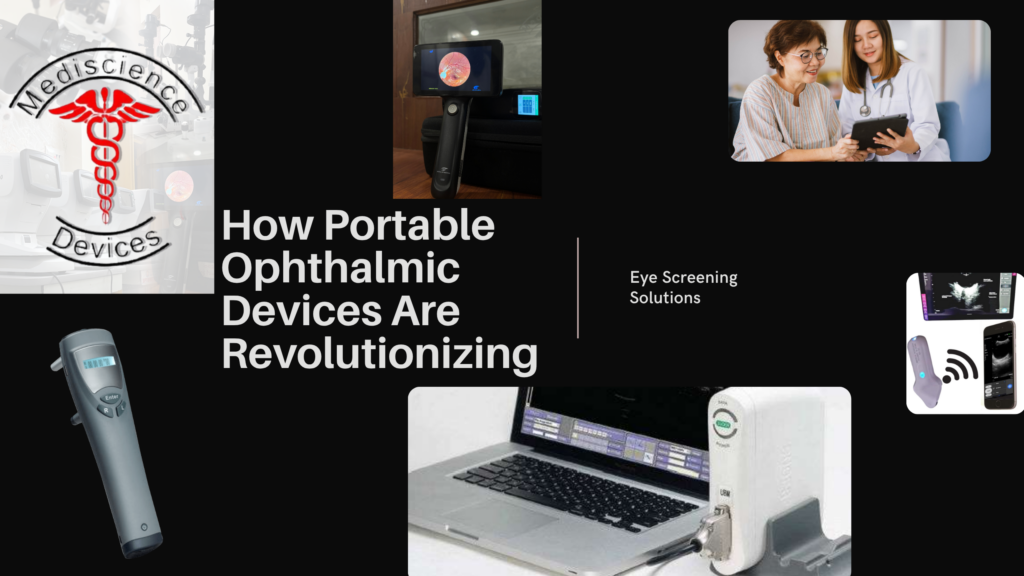
How Portable Ophthalmic Devices Are Revolutionizing Eye Screening & Diagnostics
The Evolution of Portable Ophthalmic Diagnostics in Modern Eye Care
The ophthalmology industry is undergoing a significant technological transformation. As eye care delivery increasingly expands beyond traditional tertiary hospitals into satellite clinics, vision screening camps, rural outreach units, emergency departments, and mobile healthcare systems, the demand for portable ophthalmic diagnostic devices has rapidly accelerated.
Modern ophthalmic practice is no longer confined to static, table-mounted diagnostic systems. Today’s clinicians require mobility, speed, precision, and digital interoperability without compromising diagnostic reliability.
This shift has fueled the adoption of advanced portable ophthalmic devices such as:
- Portable fundus cameras
- Rebound tonometers
- Handheld autorefractors
- Portable slit lamps
- Wireless B-scan ultrasound systems
- Mobile retinal imaging devices
- Compact vision screening systems
For ophthalmologists, retina specialists, optometrists, and eye care institutions, portable diagnostics are not merely convenience tools anymore. They are becoming critical infrastructure for scalable, efficient, and accessible eye care delivery.
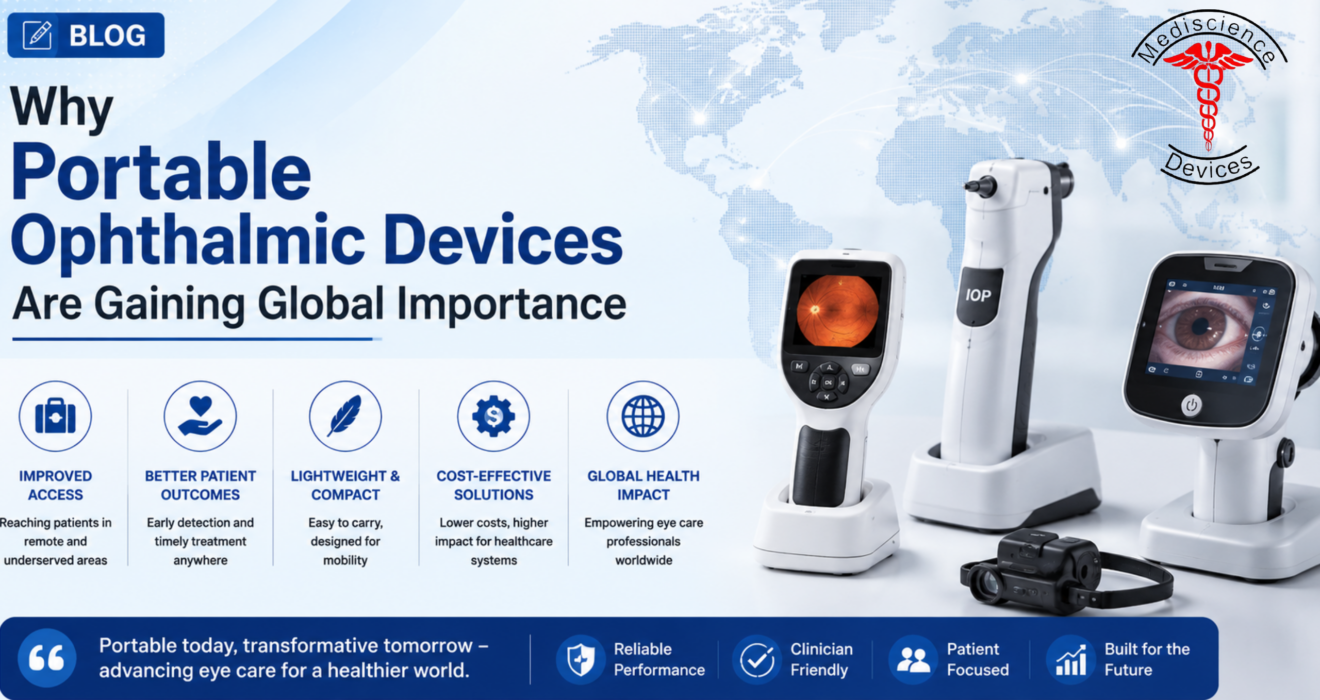
Why Portable Ophthalmic Devices Are Gaining Global Importance
Increasing Demand for Decentralized Eye Care
The prevalence of diabetic retinopathy, glaucoma, cataract, age-related macular degeneration (AMD), refractive errors, and retinal vascular diseases continues to rise globally.
Simultaneously, healthcare systems are facing:
- Increasing patient load
- Limited specialist accessibility
- Rural healthcare disparities
- Demand for faster screening workflows
- Growing teleophthalmology adoption
- Rising geriatric populations
Portable ophthalmic devices help bridge these challenges by enabling rapid diagnostics in:
- Outreach screening camps
- Secondary care centers
- Satellite eye clinics
- ICU and bedside examinations
- Community health programs
- Emergency ophthalmic assessments
- Post-operative follow-ups
- Mobile vision vans
This mobility dramatically improves accessibility while reducing patient dependency on centralized diagnostic infrastructure.
The Role of Portable Fundus Cameras in Retinal Diagnostics
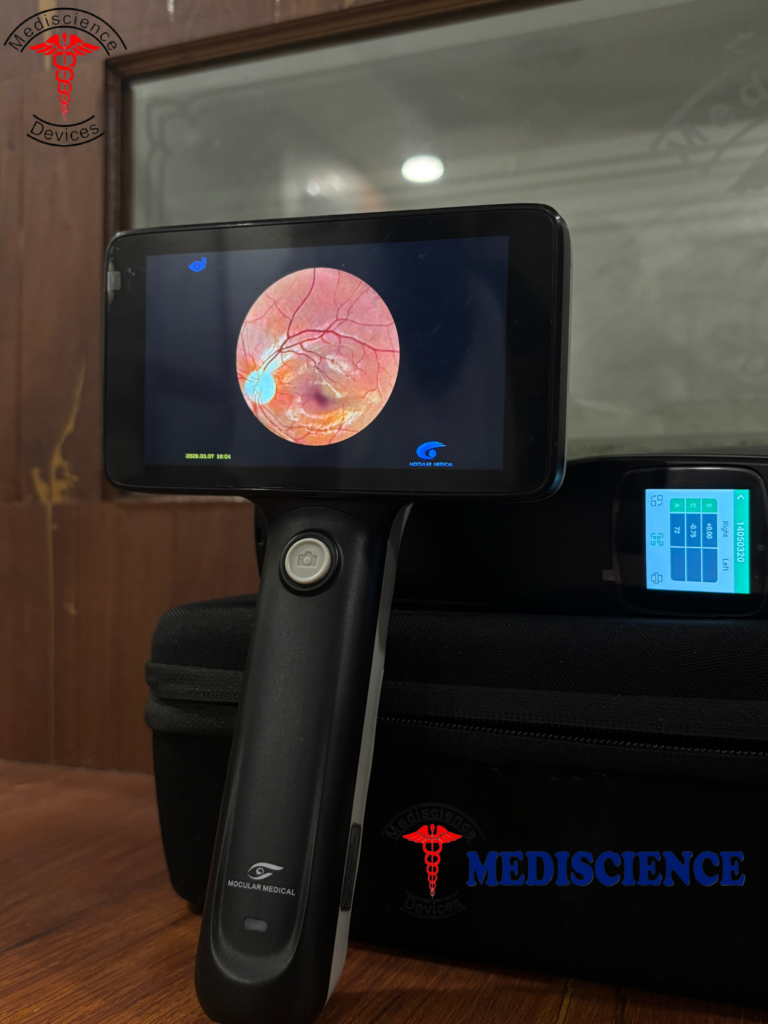
Digital Retinal Imaging Beyond the Clinic
Portable fundus cameras have emerged as one of the most transformative innovations in ophthalmic imaging.
Traditional tabletop fundus cameras often require dedicated clinical space, chin-rest positioning, trained operators, and stable infrastructure. Portable retinal imaging systems overcome these limitations while maintaining clinically useful image quality.
Modern portable fundus cameras now feature:
- High-definition retinal imaging
- Non-mydriatic imaging capability
- Wireless image transfer
- Autofocus systems
- Touchscreen interfaces
- AI-assisted image analysis compatibility
- Cloud-based reporting integration
- Telemedicine connectivity
Devices such as the portable Mocular CFC-X digital fundus camera represent how compact retinal imaging systems are redefining screening workflows.
Clinical Applications of Portable Fundus Cameras
Portable retinal imaging systems are increasingly used for:
- Diabetic retinopathy screening
- Glaucoma documentation
- Hypertensive retinopathy assessment
- Retinal vascular evaluation
- Optic disc imaging
- Teleophthalmology consultations
- School vision screening programs
- Rural retinal camps
- Emergency retinal assessments
For retina specialists and screening programs, portability substantially improves diagnostic reach and patient throughput.
Portable Rebound Tonometers and the Evolution of Glaucoma Screening

Advancing Intraocular Pressure Assessment
Intraocular pressure (IOP) monitoring remains fundamental in glaucoma diagnosis and management.
Traditional applanation tonometry methods require slit-lamp integration, fluorescein application, and high operator dependency. Portable rebound tonometers simplify the screening process significantly.
Modern rebound tonometers such as the SUOER SW-500 portable wireless digital tonometer offer:
- Rapid IOP measurement
- Minimal patient discomfort
- Portable and lightweight design
- Reduced operator variability
- Wireless functionality
- Fast screening workflow
- Pediatric and geriatric usability
- Ability to perform measurements on supine patients, making it highly useful in ICUs, post-operative wards, and bedside examinations
- Convenient assessment of both right and left eyes within the same workflow
- Integrated thermal printer for instant patient record generation and documentation
- Reduced dependence on operator technique compared with conventional applanation methods
Clinical Advantages in Outreach and Screening
Portable tonometers are particularly valuable in:
- Community glaucoma screening
- Bedside ophthalmic evaluation
- Elderly patient assessment
- Pediatric ophthalmology
- Rural healthcare deployment
- High-volume OPD environments
- Mobile vision screening camps
- Post-operative IOP monitoring
The ability to conduct fast, repeatable IOP measurements without requiring extensive setup improves both workflow efficiency and patient compliance.
Wireless B-Scan Ultrasound Systems in Modern Ophthalmology
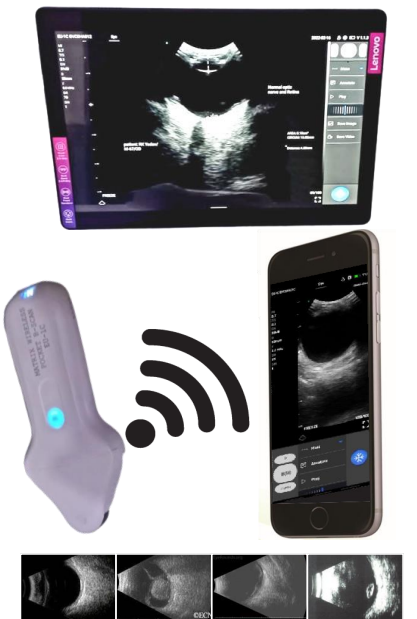
Portable Ocular Ultrasonography Is Changing Diagnostic Accessibility
Ocular B-scan ultrasonography remains indispensable in cases involving:
- Vitreous hemorrhage
- Retinal detachment
- Ocular trauma
- Posterior segment opacity
- Dense cataracts
- Endophthalmitis evaluation
- Vitreoretinal pathology
Traditional ultrasound systems are often large and infrastructure-dependent.
Portable wireless B-scan devices such as the Fujitron EU-1C digital pocket wireless B-scan now enable ophthalmologists to perform rapid ocular ultrasonography in highly flexible environments.
Advantages of Portable B-Scan Systems
Advantages of Portable B-Scan Systems
Modern handheld B-scan devices provide:
- Compact portability
- Wireless operation
- Real-time image visualization
- Faster emergency diagnostics
- Reduced infrastructure dependency
- Simplified bedside imaging
- Improved outreach screening capability
- Mass screening capability during eye camps and community screening programs
- Dual operation through a tablet or smartphone interface, making deployment significantly more portable
- Dual-frequency functionality (8 MHz and 11 MHz), allowing enhanced visualization of different ocular structures
- Orbital mode capability for evaluation of orbital pathology in addition to routine ocular assessment
- Easier screening of elderly, pediatric, bedridden, and immobile patients
- Reduced dependency on dedicated ultrasound rooms and bulky imaging infrastructure
This is particularly useful in emergency ophthalmology, trauma centers, retina clinics, rural outreach programs, and peripheral diagnostic units.
Portable Ophthalmic Devices and Teleophthalmology Integration
The Rise of Remote Eye Care Models
Teleophthalmology is increasingly becoming a core component of modern eye care systems.
Portable diagnostic devices support remote ophthalmology by enabling:
- Image capture in remote locations
- Cloud-based data transfer
- AI-assisted interpretation
- Specialist review from tertiary centers
- Faster referral pathways
- Improved rural healthcare access
Combined with electronic medical records (EMR) and digital workflow systems, portable diagnostics create highly scalable eye care ecosystems.
This is particularly important for countries with uneven specialist distribution and rapidly increasing diabetic populations.
Diagnostic Accuracy vs Portability: Has Technology Closed the Gap?
Historically, portability was often associated with compromised image quality or limited diagnostic precision.
However, advances in:
- CMOS sensor technology
- Digital optics
- AI-assisted image enhancement
- Wireless transmission systems
- Miniaturized electronics
- Portable LED illumination systems
- Battery optimization
have significantly improved the clinical utility of portable ophthalmic devices.
Today, many portable systems can provide diagnostic quality sufficient for:
- Preliminary screening
- Follow-up evaluation
- Remote consultation
- Triage assessment
- Chronic disease monitoring
While tertiary-level imaging systems still remain essential for advanced subspecialty diagnostics, portable devices now serve as highly reliable frontline screening tools.
Portable Ophthalmic Devices in High-Volume Clinical Workflows
Workflow Efficiency and Patient Throughput
High-volume ophthalmology practices increasingly prioritize workflow optimization.
Portable diagnostic devices help reduce:
- Patient movement between stations
- Diagnostic bottlenecks
- Waiting time
- Setup dependency
- Technician workload
In outreach or secondary care environments, portability allows clinicians to bring diagnostics directly to the patient rather than moving patients between multiple examination areas.
This becomes particularly valuable in:
- Cataract screening camps
- Diabetic eye screening programs
- Geriatric eye care
- ICU ophthalmology consultation
- Post-operative assessments
Infection Control and Portable Diagnostics
A Post-Pandemic Perspective
The COVID-19 era fundamentally reshaped healthcare workflow design.
Portable ophthalmic devices contributed to safer clinical workflows by:
- Reducing patient crowding
- Minimizing movement between diagnostic stations
- Supporting faster examination protocols
- Enabling decentralized assessments
- Improving infection control strategies
This has accelerated long-term investment in portable ophthalmic technology across hospitals and private eye clinics.
Key Considerations Before Purchasing Portable Ophthalmic Equipment
Eye clinics and hospitals should evaluate several factors before investing in portable ophthalmic devices.
Clinical Reliability
The device should provide clinically dependable diagnostic performance.
Service Support Availability
Regional technical servicing remains critical for long-term reliability.
Image Quality & Software Compatibility
Devices should integrate efficiently with modern digital workflows.
Portability & Battery Performance
Portable systems must maintain adequate operational stability during field deployment.
Data Transfer Capability
Wireless integration and cloud compatibility are increasingly important.
Regulatory and Quality Standards
Clinics should procure devices from trusted ophthalmic equipment suppliers with reliable after-sales support.
The Future of Portable Ophthalmic Technology
Portable ophthalmic diagnostics are expected to evolve further with:
- AI-assisted disease detection
- Smartphone-integrated imaging
- Cloud-based ophthalmology platforms
- Automated retinal analysis
- Remote glaucoma monitoring
- Portable OCT systems
- Real-time teleophthalmology consultation
- Predictive diagnostic analytics
As ophthalmology increasingly moves toward preventive and scalable healthcare models, portable devices will continue playing a central role.
Why Portable Equipment Servicing Is Easier with Mediscience Devices
One of the often-overlooked advantages of portable ophthalmic equipment is the simplicity of service logistics. Unlike conventional tabletop systems that may require on-site engineer visits and complex transportation arrangements, portable devices can often be shipped quickly and safely for evaluation.
At Mediscience Devices, if a local service engineer is unavailable or immediate field support may take time, clinics can courier the portable device directly to our service facility. Upon receipt, our technical team performs a detailed diagnostic evaluation and identifies the nature of the issue.
In situations where the assessment indicates that repairs may require more than five working days, Mediscience can arrange a replacement or alternative unit to minimize disruption to clinical operations. Once the original device has been repaired, tested, and validated, the temporary replacement unit can simply be couriered back.
This service model offers several advantages:
- Reduced equipment downtime
- Faster technical assessment
- Continuity of patient care
- Minimal disruption to clinic workflow
- Cost-effective service logistics
- Improved support for remote and underserved regions
This approach is particularly valuable for eye clinics operating in tier-2 and tier-3 cities, outreach programs, mobile eye care units, and institutions where uninterrupted diagnostic capability is essential.
Beyond equipment supply, Mediscience Devices remains committed to long-term technical support, preventive maintenance, and dependable after-sales service to ensure that portable ophthalmic devices continue delivering reliable clinical performance throughout their operational lifecycle.
Final Thoughts
Portable ophthalmic devices are fundamentally reshaping how modern eye care is delivered.
From retinal imaging and glaucoma screening to emergency ultrasonography and teleophthalmology integration, portable diagnostics are expanding the reach, efficiency, and accessibility of ophthalmic care.
For ophthalmologists, eye clinics, and healthcare institutions, investing in portable ophthalmic technology is no longer simply about convenience. It is about building scalable, future-ready diagnostic ecosystems capable of meeting the increasing global demand for eye care.
As technology continues advancing, portable ophthalmic systems will become increasingly central to preventive screening, decentralized diagnostics, and digitally integrated ophthalmology.
Check the list of portable ophthalmic equipment and discuss your device requirements. Connect with Mediscience Devices today.
Frequently Asked Questions (FAQ)
Portable ophthalmic devices are compact diagnostic tools designed for mobile eye care applications, including retinal imaging, tonometry, ultrasonography, and vision screening.
Portable fundus cameras improve retinal screening accessibility, support teleophthalmology, and enable retinal imaging in outreach and remote healthcare settings.
Modern rebound tonometers provide reliable intraocular pressure measurements suitable for glaucoma screening and routine ophthalmic assessments.
Regional service availability ensures faster technical assistance, reduced downtime, easier spare part access, and quicker issue resolution.
Portable devices allow image capture and diagnostic data transfer from remote locations to specialists for faster interpretation and consultation.